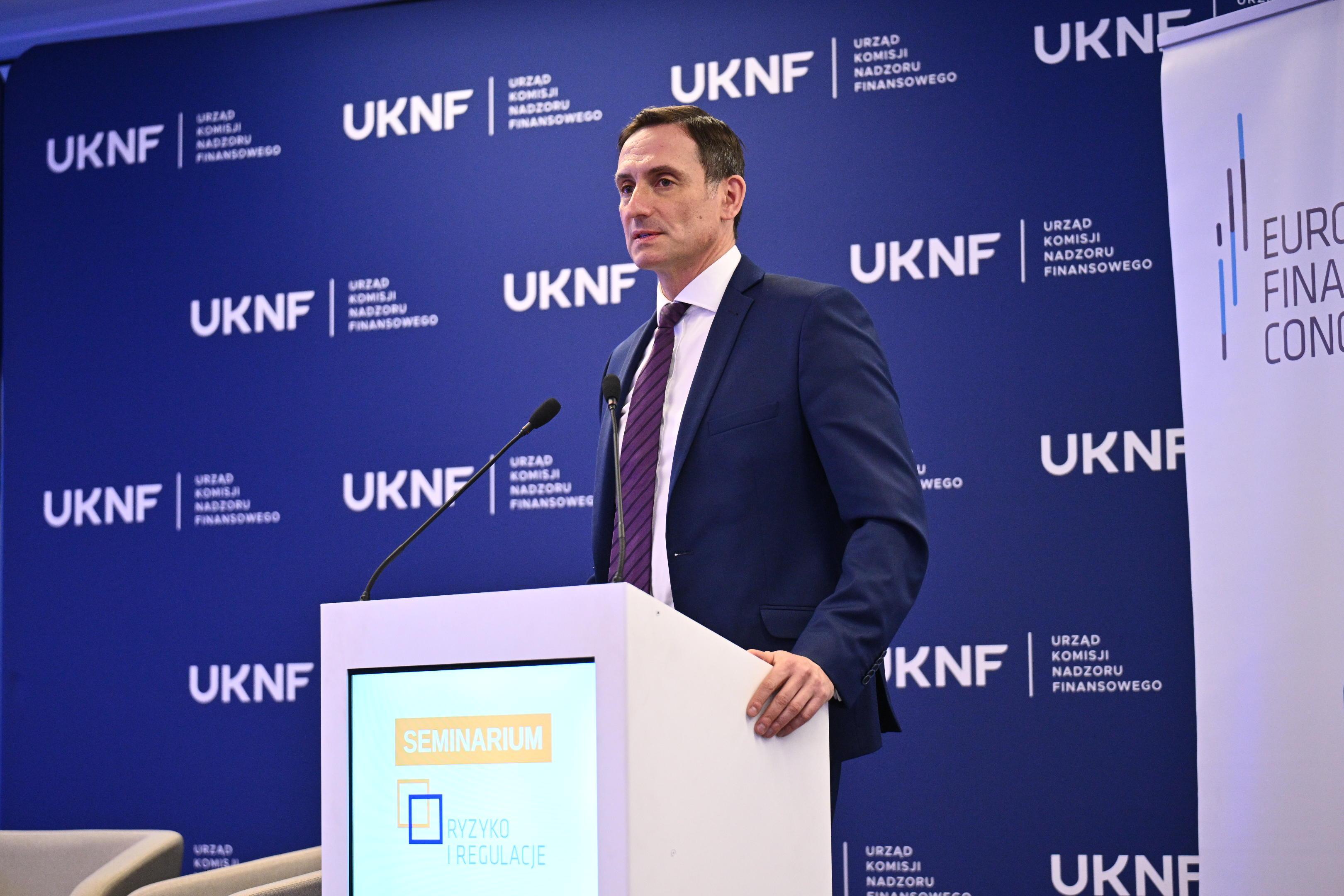
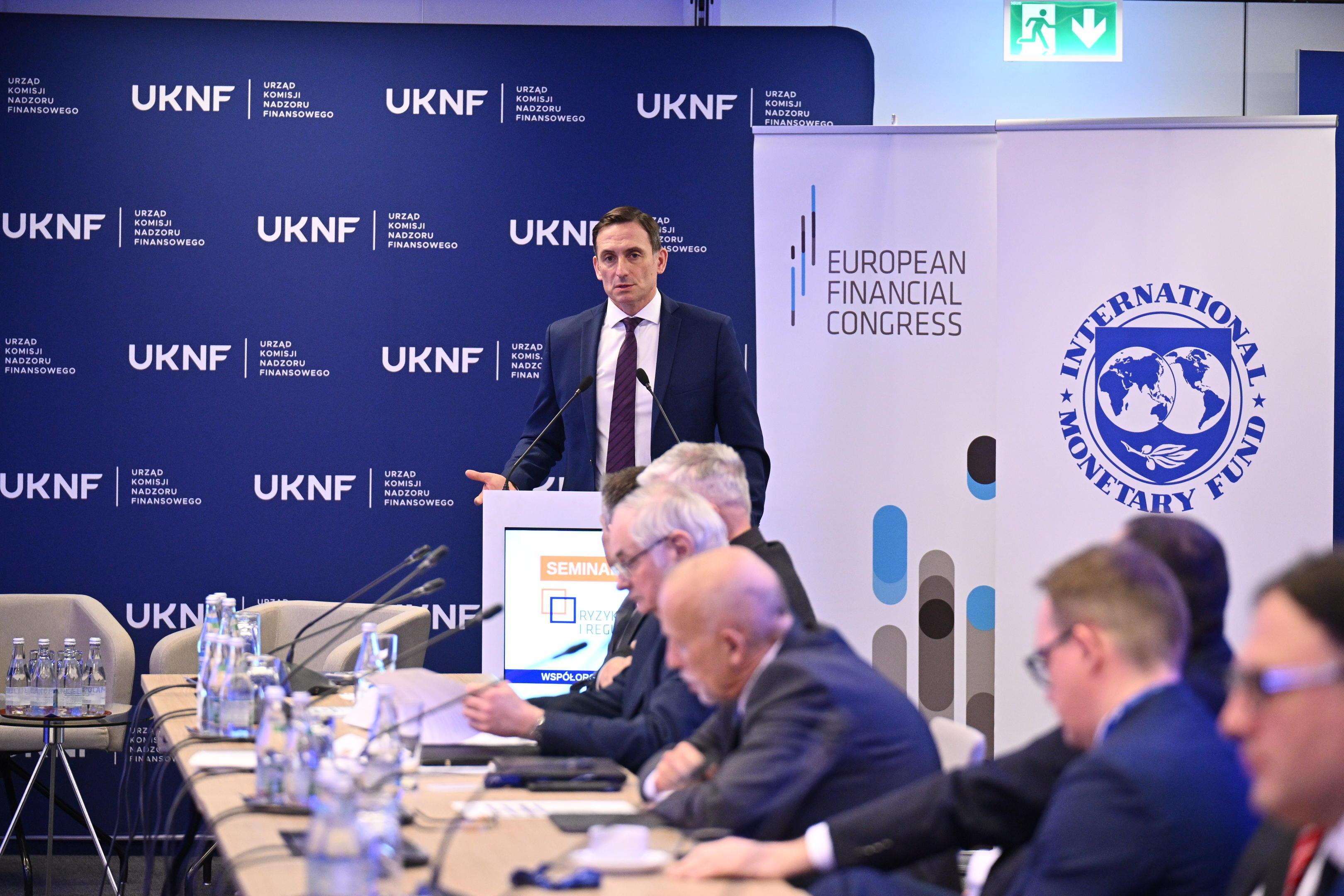
Dariusz Adamski spoke at ‘Risk and Regulations in the Financial Market’ seminar
Dariusz Adamski, Deputy Chair of the KNF, gave a speech at the introduction to the ‘Risk and Regulations in the Financial Market’ seminar. The event is organised by the UKNF in cooperation with the European Financial Congress. This year’s edition is also co-organised by the International Monetary Fund. This year the seminar is focused on the role of the capital market in long-term economic development financing.
In his speech, Dariusz Adamski referred to the financing of large investments and the role of the Polish capital market in mobilising domestic savings. He gave an example of a large infrastructural project in which three banks declared the financing of a few billion zloties while the total cost amounted to a few dozens of billions. This disproportion raises questions about the source of funds to cover the capital gap, as well as questions why the capital market is so rarely mentioned in public discussions as a natural place for capital raising.
The Deputy Chair of the KNF suggests that the tendency to overlook the Polish market results from the historical habit of using foreign capital that supported Poland’s economic development for years. Today, however, the situation is different as significant savings have been already accumulated in the country, both in deposits and in investment funds. The problem is not a lack of capital, but rather that it is not being directed sufficiently towards the financing of development investments. This is why the KNF also perceives its role as the role of an institution that supports the development of the market and the deployment of accumulated funds in a more productive manner.
Dariusz Adamski assigns a special role to pension products, which are intrinsically long-term and stable. Schemes such as employee capital plans (PPK) or individual retirement security accounts (IKZE) may be a cornerstone of the Polish investment capital but require regulatory adjustments so that their accessibility and attractiveness for wider social groups can be increased. He also notes that short-term investing often leads to market participants making bad decisions, while pension products favour stability and better investment results. He also mentioned the need for a change in open pension funds (OFE), which would enable the removal of negative consequences of the safety ‘slider’ for the capital market in the perspective of the next few, maybe more than ten, years.
Yet another important topic is the development of new instruments and financial institutions. The Deputy Chair of the KNF emphasises that Poland has no private-market infrastructural funds or REITs, which could allow the financing of infrastructural or real property projects by a wide group of investors. The introduction of the former will become easier with legislative changes aimed at introducing Qualified Investment Funds. In this context, a significant role should also be played by a modern innovation policy, as the capital market develops best where there is a large number of new, growth-oriented, promising projects.