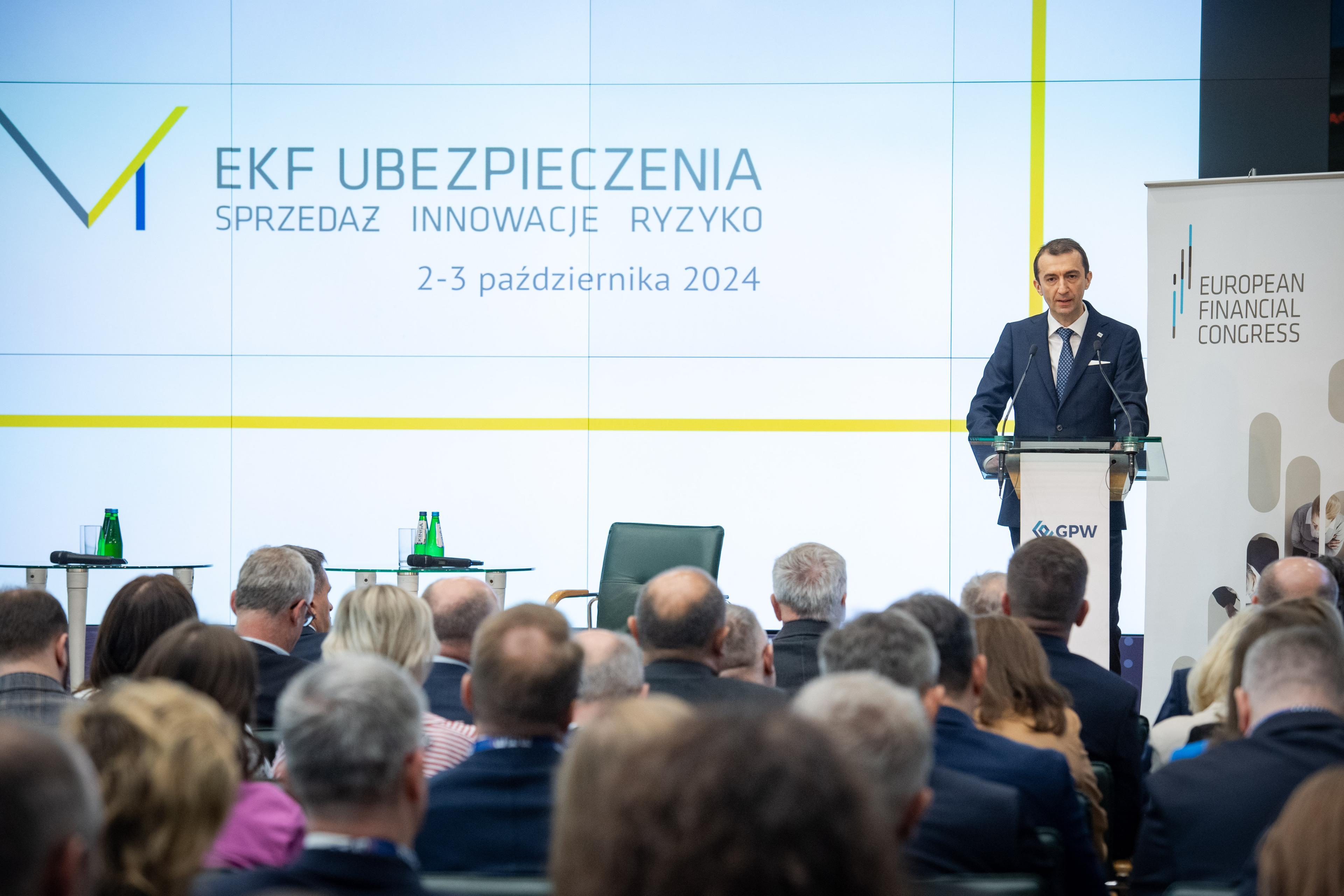
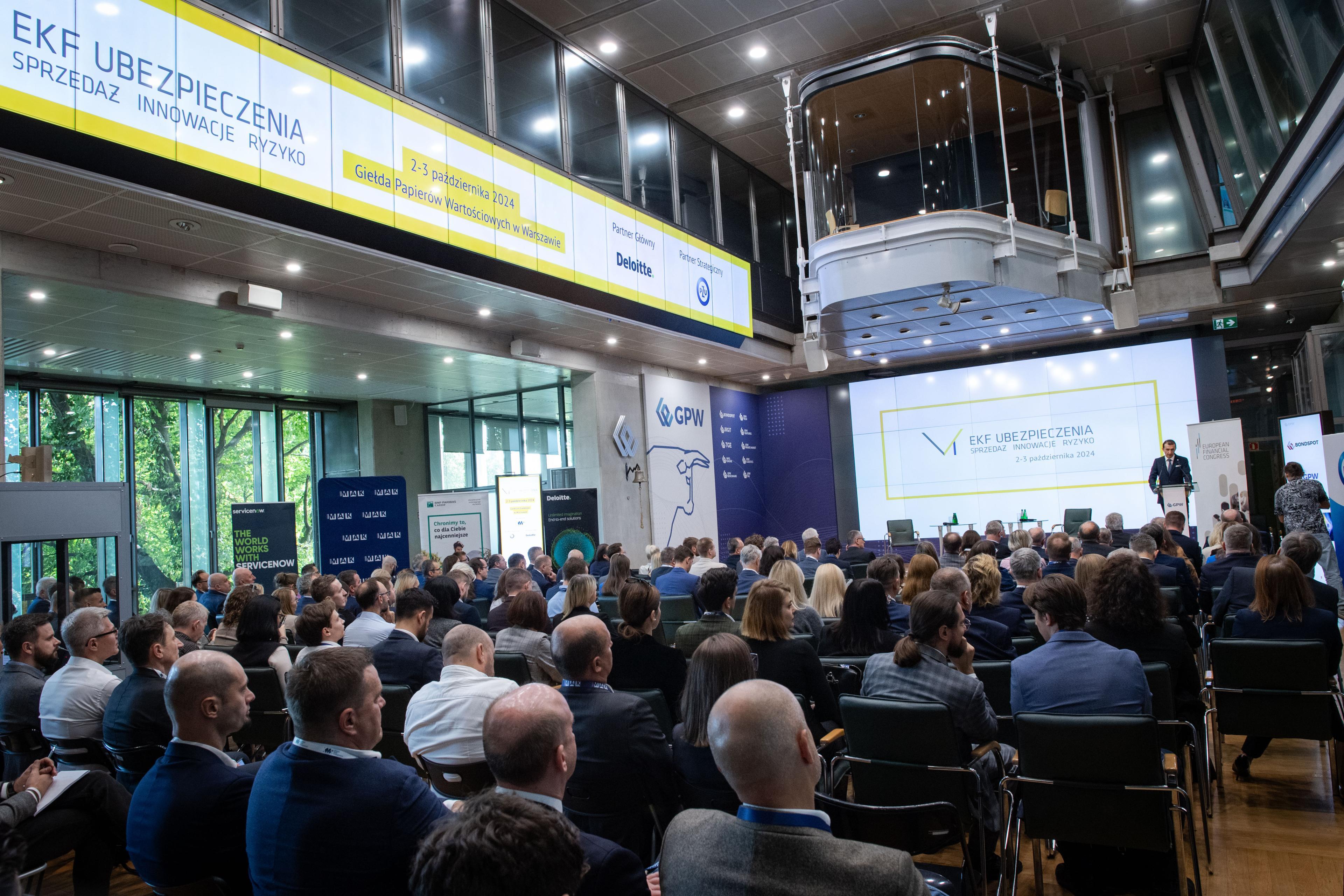
Opening speech at European Financial Congress/Insurance by Krystian Wiercioch, Deputy Chair of Komisja Nadzoru Finansowego
Ladies and gentlemen!
With great pleasure I take this opportunity to speak at the opening of the ‘European Financial Congress/Insurance: sales, innovation, risk’ conference. I want to give my warm thank-you to the organisers for this opportunity.
This conference gathers representatives of all entities from the insurance sector: insurance companies, insurance distributors, state institutions responsible for the functioning of the insurance sector, academics, and other insurance-related entities.
With such broad representation, during the two days’ conference we have the opportunity to address topics of key importance to the insurance market related to distribution, innovative products and services, and future prospects for the insurance market. In my speech I would like to share my thoughts on how the insurance supervision authority understands proper market development. Development based on stability and security.
In the first part of my speech I’m going to try to answer the question whether the insurance sector in Poland has the capacities and the potential for development according to international statistics in order to tell you, in the second part, how in my view market development can be ensured in a safe and stable way, without generating risks in the future.
Opportunities for development of the sector
If we look at current international statistics and indicators showing the size and potential of the insurance sector, such as per capita gross premium in direct business in relation to GDP, we will see that compared to other countries of the European Union we perform below our own expectations and aspirations, placing ourselves somewhere near the lowest rate. To some extent we could explain this with the fact that a large part of the society and businesses do not treat voluntary insurance as an essential product, and in the European Union we are still among countries that are getting themselves established financially. This is shown by, for example, Poland’s GDP per capita by purchasing power parity, which is less than 80% of the value of this ratio for the whole European Union and ranks us only 20th.
The statistics on EU countries show that the spending on insurance in relation to GDP in each country is strongly correlated with that country’s GDP per capita by purchasing power parity.
At the same time, one cannot ignore that during the last ten years the Polish economy has made huge progress and is now the sixth economy in the EU and the 21st in the world. We all can see that during our membership in the EU there has been a spectacular increase in wealth of the whole society and the situation in the labour market has improved. Poland is among top EU countries with the lowest rate of the risk of poverty or social exclusion and unemployment rate.
These are the factors that normally should increase the spending on insurance and be conducive to the development of the insurance market, especially in the area of voluntary insurance. Unfortunately, for over a decade we have been struggling with a very different phenomenon, as the level of gross premiums in direct business in relation to GDP reached its peak in 2008, i.e. 4.6%, and gradually declined in subsequent years, reaching its minimum in 2022, i.e. 2.2%, and that level is more than twice as low as the median of that rate for the other EU countries. This means that the insurance premium’s growth rate was lower than the GDP growth rate and that the development of the insurance market, despite an improving macroeconomic and social situation, was still limited and below the potential of the Polish economy.
In addition to growth enhancing statistics, Poland is also a country of chance events. Both mass events like road accidents, theft, inundation, as well as catastrophic ones like hailstorm, freeze, gale and, most of all, floods that we can see right now. Today and tomorrow, while talking about the opportunities for the Polish market, we are going to try to answer the following questions: What are the causes of the lack of a dynamic development of the insurance market in Poland? And what should be done to eliminate those causes?
Education in the area of insurance
The necessary element of the development of the insurance market in Poland is basic education in the area of insurance. The goal should be to indicate the role of insurance for each citizen and the role of insurance in the economy. For insurance products offered to retail customers, education is somewhat impeded by the variety of insurance products being offered, mainly the lack of product standardisation.
Even the most common types of insurance offered to consumers such as car accident and theft insurance, house insurance, international travel insurance or so-called school insurance vary across insurers. For this reason they cannot be presented as standard products and customers cannot understand the scope of such insurance. The problem could be solved with the standardisation of products offered to retailed customers so that the minimum coverage is consistent within a given product and appropriate to the customers’ typical needs.
Of course I realise that such standardisation won’t be easy: it would require all insurance market entities to collaborate in the process of manufacturing the products and to arrive at some kind of compromise as to their scope.
Insurance products
In order to ensure a stable and safe development of the insurance market we need high-quality insurance products. High-quality products are those that build the confidence in insurance companies and distributors and encourage customers to buy new products, including the ones they have never used before. Today I would like to talk about three parameters of products for retail customers which determine the product’s quality. These parameters include: the scope of the insurance contract, the amount of the sum insured, and exemptions from liability.
As regards the scope of high-quality insurance, it should be broad enough to cover all typical risks (all risk insurance) and additional risks as a logical complement to the insurance product. Typical risks are the most frequent ones that should naturally be classified as one category, so that the policyholder can receive assistance or compensation in the case of all typical chance events related to a given element of the property insured. We can measure product quality in this context with the rate of refusal to pay compensation which should remain as low as possible. An excessively high rate means that the customer was convinced that the scope of coverage under the contract they were entering into was different than the actual coverage they received.
The second parameter is the sum insured, which should be at an appropriately high level, that is the level of the maximum loss the insured may incur in terms of the insured risk. For property insurance, this is a level close to the value of the property insured. A contract providing for a sum insured which represents only a fraction of the value of the property insured should be concluded only in exceptional and justified circumstances: at the explicit request of the policyholder.
Insurance companies play an important role in determining the sum insured, especially for assistance insurance products, such as insurance of costs of medical treatment while abroad. The insured usually cannot figure out the level of costs of the assistance services or medical treatment neither in or outside Europe. Insurance companies, on the other hand, have data which clearly show what minimum value of the sum insured is necessary to cover the costs of the treatment that have been recorded in the history of accidents in a given country, or the costs of assistance and rescue services. It is the duty of the insurance company as product manufacturer to rely on such data to determine the sum insured appropriate to the risk.
Preparing and offering product variants with inappropriate sums insured is harmful to the insurance market as it undermines the confidence in that market. Such products also give a wrong impression that insurance in general fails to provide proper protection, so there’s no point buying it. If insurance companies want to foster growth and promote insurance they should offer contracts with appropriately high sums insured and even consider, as part of their own business and image strategies, refusing to conclude contracts under which the sum insured is underestimated.
Exemptions under a contract of insurance should serve as a tool to eliminate risks that are certain or impossible to value and insure, or to limit insurance crime. However, exemptions from liability should not deplete insurance cover or eliminate typical risks. Products with a high number of exemptions related to typical risks for a given type of insurance do not achieve anything and should never be offered, especially to retail customers.
Insurance distribution
Using the opportunity of having insurance distributors present, I would like to refer to their role in the development of the insurance market in Poland.
Already at the time of the first contact with a potential customer, especially a retail customer, who seeks insurance cover, the role of the distributor is to raise awareness of insurance. To indicate how insurance can protect various components of the customer’s property, their life or health. Although provisions of law do not explicitly require it, such action is the sign of the distributor’s professionalism.
The law does require the distributor, however, to ask the customer about the customer’s needs and requirements before executing the insurance contract. Before moving to that stage, the distributor should explain the purpose of such conversation as well as the consequences of the customer’s failure to provide key information or failure to provide accurate information.
The quality of the analysis of customer needs – the choice of questions, the degree to which the customer understands the questions, the complexity of the conversation, the clarification of inconsistencies in the information received, and first of all the ability to analyse the answers – is of key importance because it determines whether the customer will receive the right insurance coverage. Especially because very often the customer has no knowledge in the field of insurance and cannot judge correctly what protection they need and what scope of protection can be offered by the insurance sector.
Based on information obtained through the analysis of customer needs, the distributor should establish the circumstances against which the customer wants to be insured and the customer’s requirements regarding the insurance. The distributor should also establish what amount of the sum insured meets those needs and requirements. In property insurance, if the value of the property insured can be calculated precisely or estimated, a good practice should be to offer a sum insured which is appropriate to that value and equal to the maximum potential loss.
Following the analysis of customer needs, the distributor should give the customer only such proposals for a contract which are compatible with the customer’s needs and requirements regarding insurance cover. The distributor should not present any proposals that are incompatible with the identified needs and requirements, as this would create a misconception that the proposals are also recommended by the distributor.
The requirements on the analysis of customer needs impose a large extent of liability on the distributor. It is the distributor’s professionalism and honesty that determine whether in case of an accident the customer’s property, life or health will be properly protected. Distributors should be aware of their responsibility for customers and for the way insurance is seen in general.
Flood as a test of credibility
Now I’d like to refer to the current flood events in Poland in the context of building the confidence in the insurance sector.
Flood is a huge tragedy for the people affected by it, whose property has been destroyed. It is also a test of the operation and credibility of the insurance sector. A test to check whether insurance actually works when it should. A test to check whether all the parameters of the insurance contract have been defined correctly: whether the scope of insurance covers the risk of flood and whether the sum insured is sufficient to cover the actual losses. It’s also a test of the quality of insurance distribution which checks if the customers’ needs have been analysed properly and if the proposed insurance contract is appropriate to the needs identified.
How the insurance sector will perform in that test is something we will know in a couple of months, when the claim settlement procedures are over and the final payments are made.
The only thing we can evaluate right now are the actions taken by the sector during the first days of the flood. The opinion is positive: insurance undertakings have taken actions to ensure that the injured parties entitled to insurance coverage get help as soon as possible.
Further steps are equally important: smooth claim settlement, the payment of adequate compensation to the insured, and being open to the alternative resolution of disputes, if any.
***
In summary, the insurance market in Poland is characterised by high potential for development. But we need customers who are aware of risks and ways to mitigate them with insurance products. We also need high-quality products with a high sum insured which can be purchased by well-informed customers. We also need distributors who will be able to offer high-quality products to well-informed customers and reach the customers who do not have the right understanding in order to create that understanding.
In case of a loss, what we need is the insurance companies’ empathy for the injured party and efficient assistance action.
In a long term, such approach is not only profitable to insurers, as the sales of insurance products will be increasing, but also because customers will have less reasons to challenge their insurance contracts or question the proper performance of those contracts by the insurers. It is a way to reduce legal risk and the costs of litigation with customers and compensation offices, but also a way to minimise the likelihood of government intervention.
This is why we, as the supervisor, focus so much on the quality and value of products, product distribution and claim settlement. I encourage everyone to look at the customer-insurer or customer-distributor relationship as a long-term relationship. The relationship is reinforced by the customer’s conviction that the money used to buy an insurance policy has been spent well and that it was worth it.
Finally I would like to wish you interesting and constructive discussions about the future of insurance in Poland during the panels and debates scheduled for this conference. My colleagues, Director Daria Ringwelska and Director Maciej Podlewski, are taking part in the discussions as well. Everyone is also welcome to talk to us backstage; me and my colleagues will be glad to answer your questions and exchange comments.