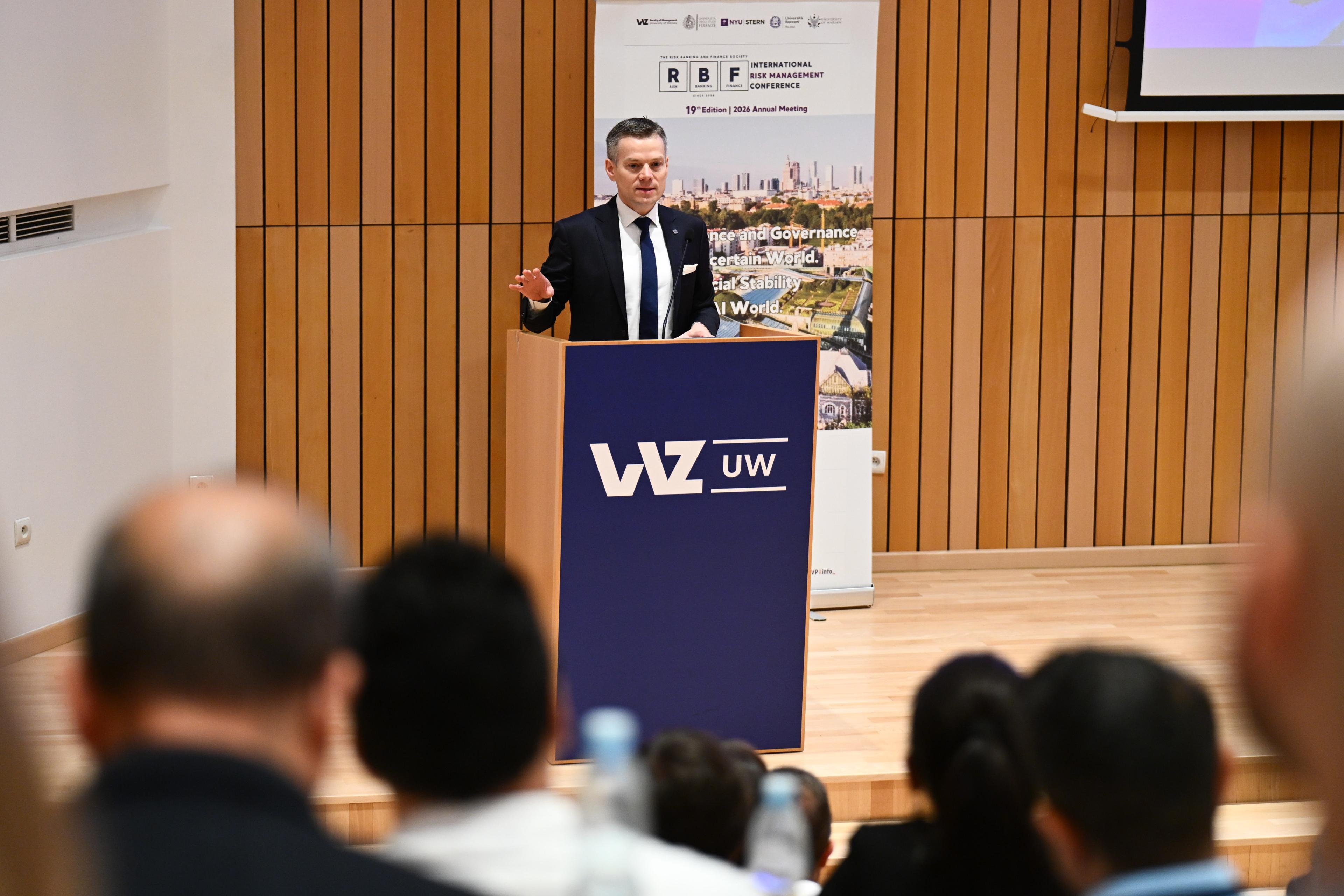
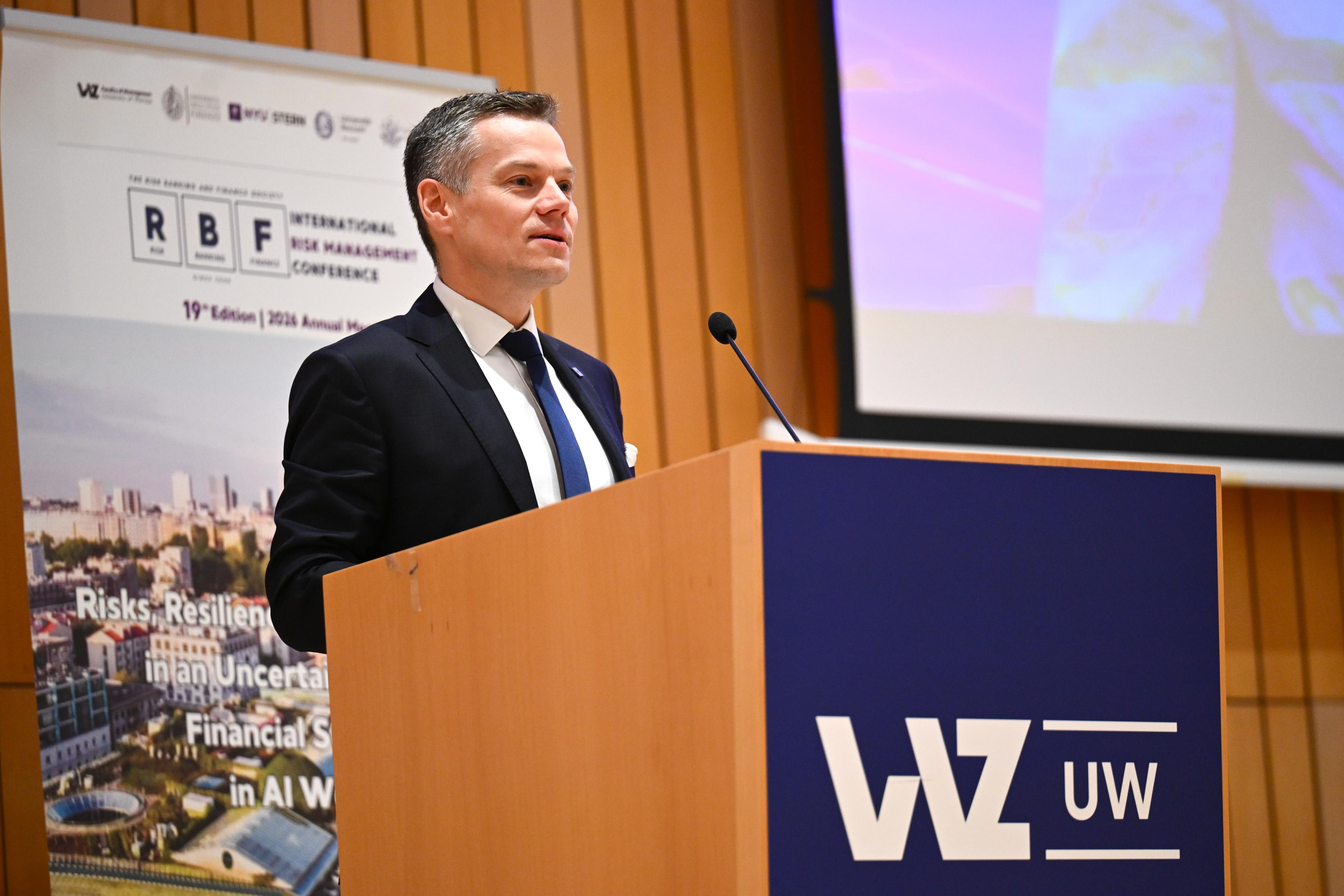
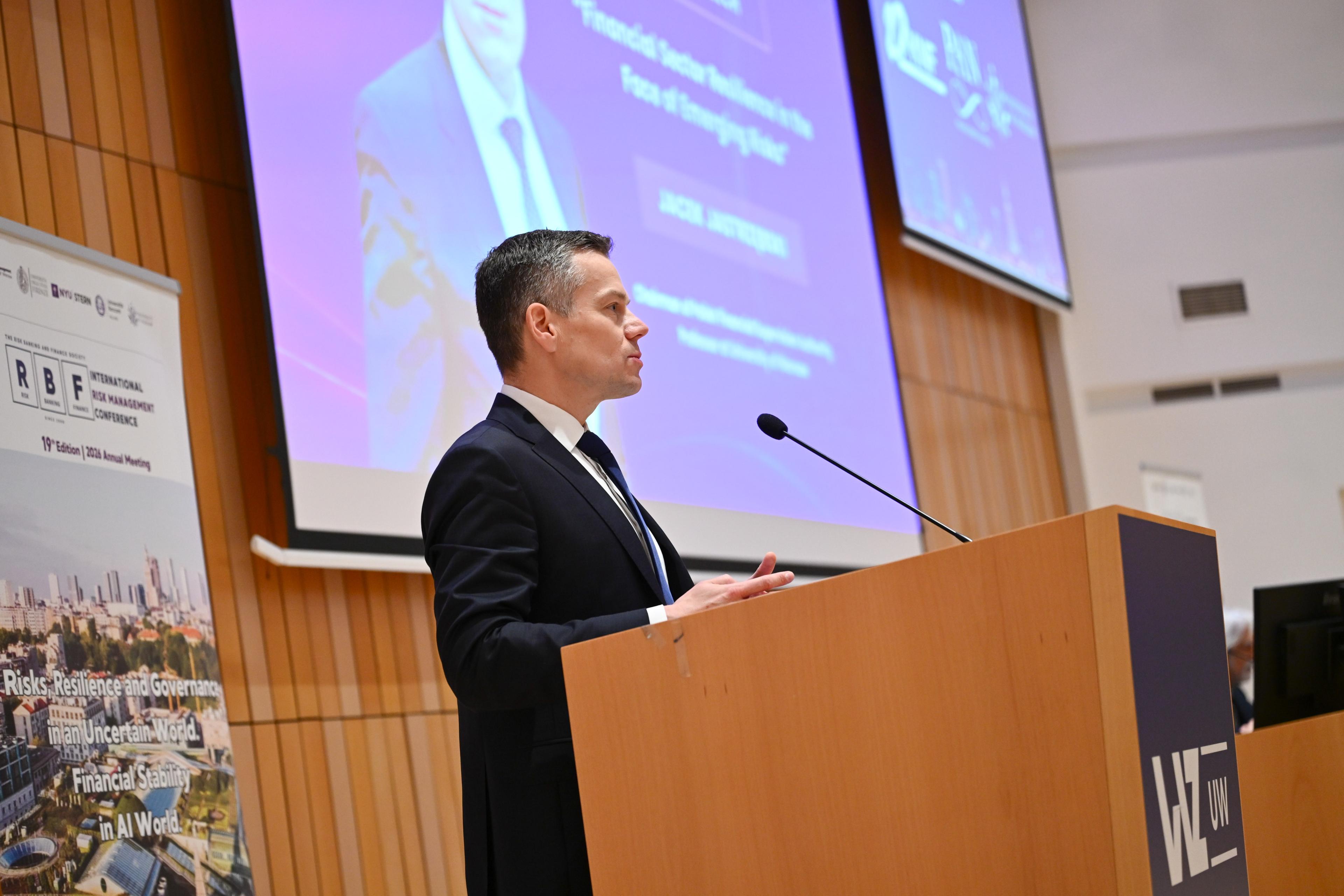
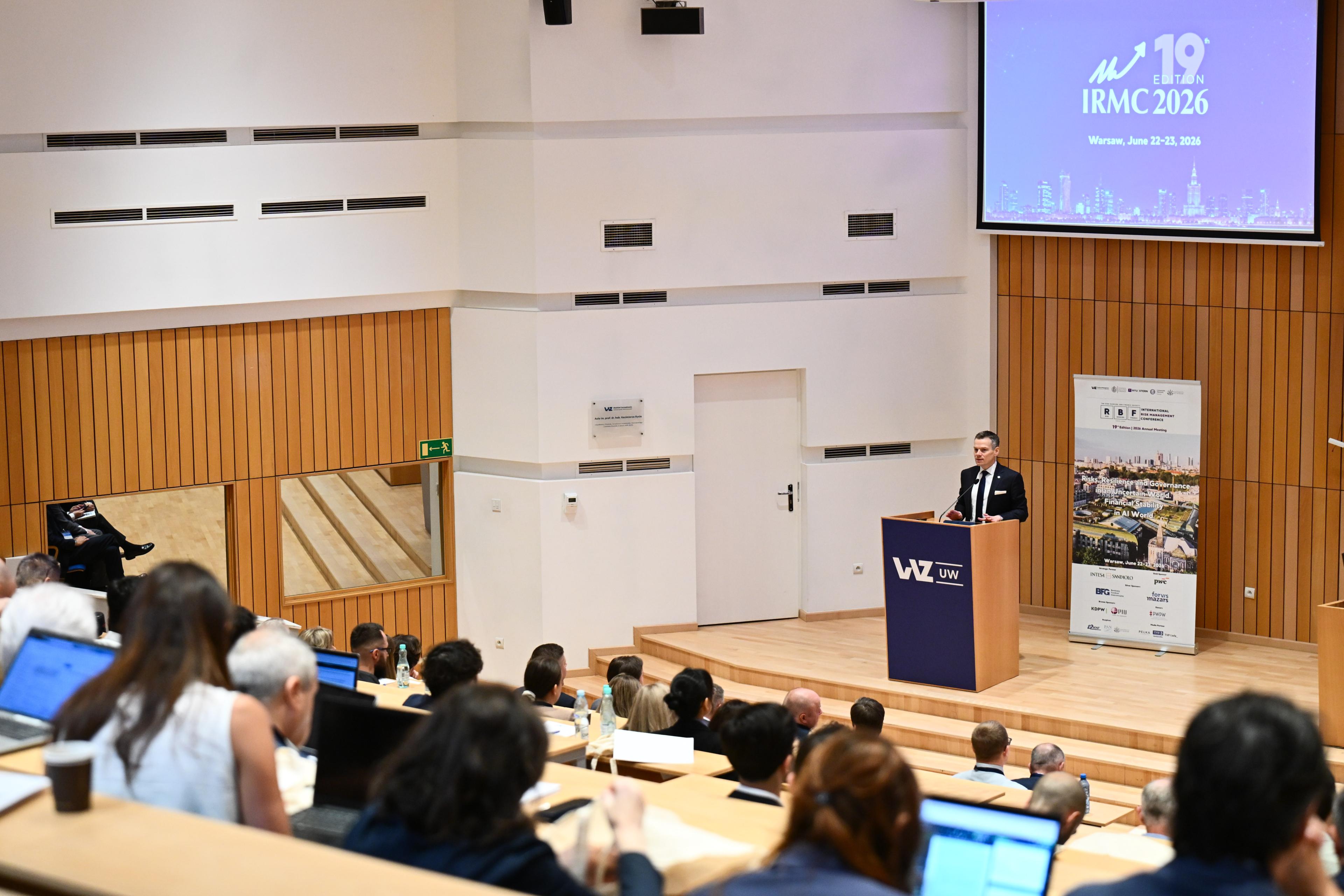
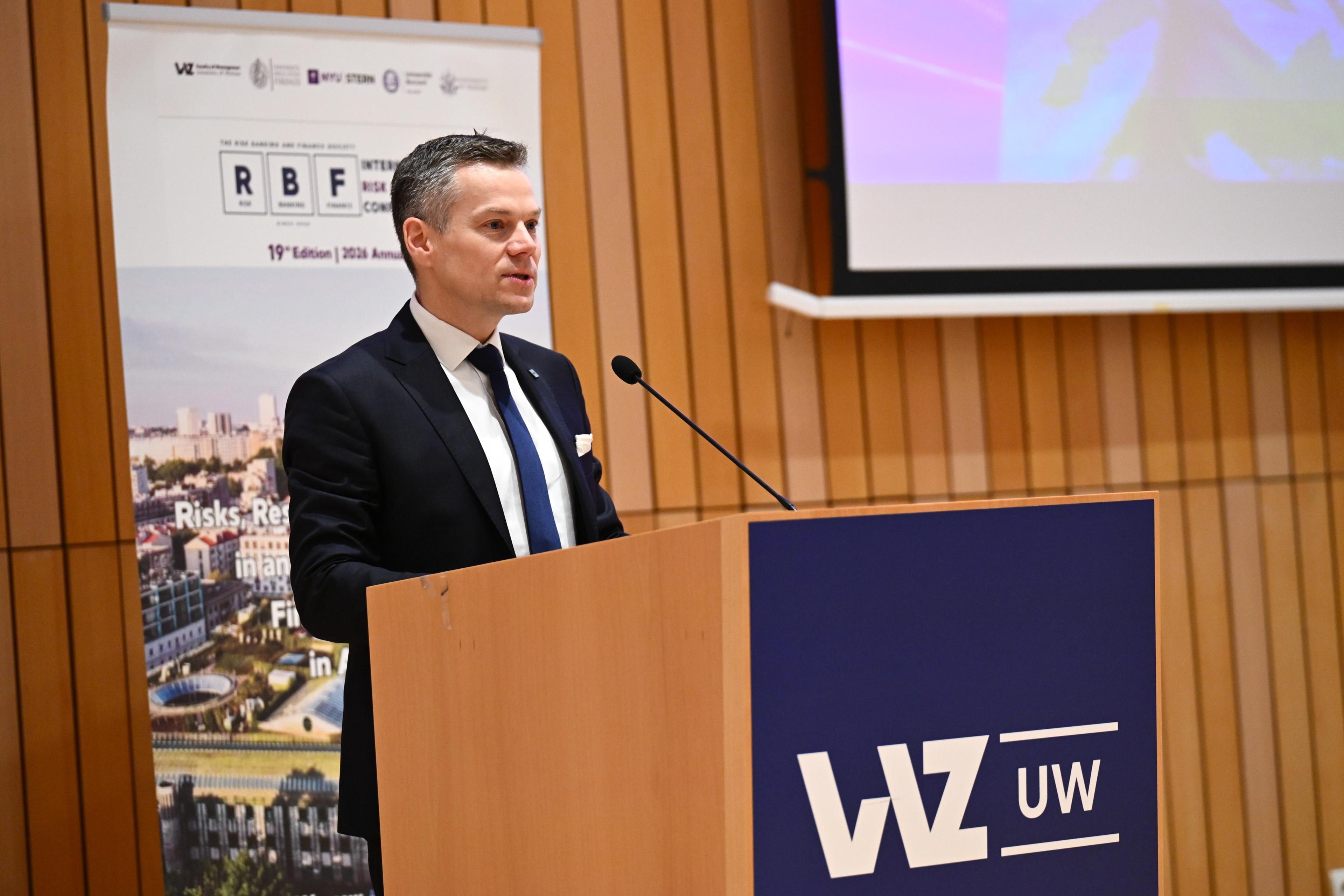
Jacek Jastrzębski opened International Risk Management Conference 2026
Jacek Jastrzębski, Chair of Komisja Nadzoru Finansowego (KNF), spoke at the opening of the International Risk Management Conference 2026 – a conference dedicated to risk management, financial stability, and corporate governance. This year’s conference host is the Faculty of Management of the University of Warsaw, and the KNF has assumed patronage of the event.
The conference in Warsaw takes place under the theme: ‘Risks, Resilience and Governance in an Uncertain World. Financial Stability in an AI World’ and focuses on (1) the impact of artificial intelligence (AI) on the financial system, (2) regulations, and (3) the practice of risk management.
In his speech, Jacek Jastrzębski talked about risk management, resilience and stability of the financial system in a world of growing uncertainty. The starting point was an observation that modern economies are permanently exposed to shocks: from the COVID-19 pandemic, through geopolitical tensions and the war in Ukraine, to challenges related to AI development.
In this situation, resilience is becoming a key concept, which should be distinguished from the concept of stability. Stability is the capability of a system to recover after a disruption, while resilience is the ability to adapt to new conditions, absorb shocks and maintain basic functions even when the environment undergoes irreversible changes. The distinction is particularly relevant for the financial sector these days, as we can see more and more situations that, once they have occurred, prevent restoration of the previous state of balance. Therefore, what becomes essential is not to reproduce the past order of things but to maintain the capability to operate in new realities.
An example of so defined resilience is the Ukrainian financial sector, operating in wartime conditions. Despite extremely harsh circumstances, Ukraine’s financial system has maintained its ability to provide basic services, avoiding major disruptions and insolvency of financial institutions. This shows that real resilience is not about coming back to the state existing prior to a crisis but about working effectively in a completely new environment.
In the next part of his speech, Jacek Jastrzębski highlighted the difference between risk and uncertainty. Risk can be modelled, and specific probabilities can be assigned to it, while uncertainty occurs for phenomena which cannot be reliably predicted or captured in statistical models. This applies, among other things, to the effects of development of advanced AI, geopolitical changes or the consequences of climate change. What’s needed when facing such phenomena is humility and the awareness of restrictions inherent to analytical models. A financial system may be well prepared for known threats, but it remains vulnerable to so-called ‘unknown unknowns’.
A situation like that should be addressed with strong, credible institutions. The Chair of the KNF referred to a concept coined by Douglass North, who pointed not only to efficient use of resources but also to ‘adaptive efficiency’, or the capacity of societies and organisations to learn, innovate and adjust the rules to changing circumstances. Under this approach, resilience means capacity to adapt continuously. What is particularly relevant here is the quality of law and predictability of its application as well as the credibility of institutions responsible for law enforcement. These are the areas where the society and the State have a real influence, as opposed to many external sources of uncertainty.
When wrapping up his speech, Jacek Jastrzębski stressed that resilience did not consist in protecting oneself, as much as possible, from known threats but in staying adaptable to unpredictable challenges. This is why efforts are needed to promote diversity instead of homogeneity, to create safety buffers instead of seeking extreme optimisation, and to build structures capable of decentralising and delegating powers. Such an approach increases the chances for efficient performance even during deep crises. The ultimate task of the financial supervisor and public institutions is not to eliminate uncertainty but to create conditions which will allow the system to survive unexpected events. Real wisdom begins with recognising that the full knowledge of the future is unavailable to us.