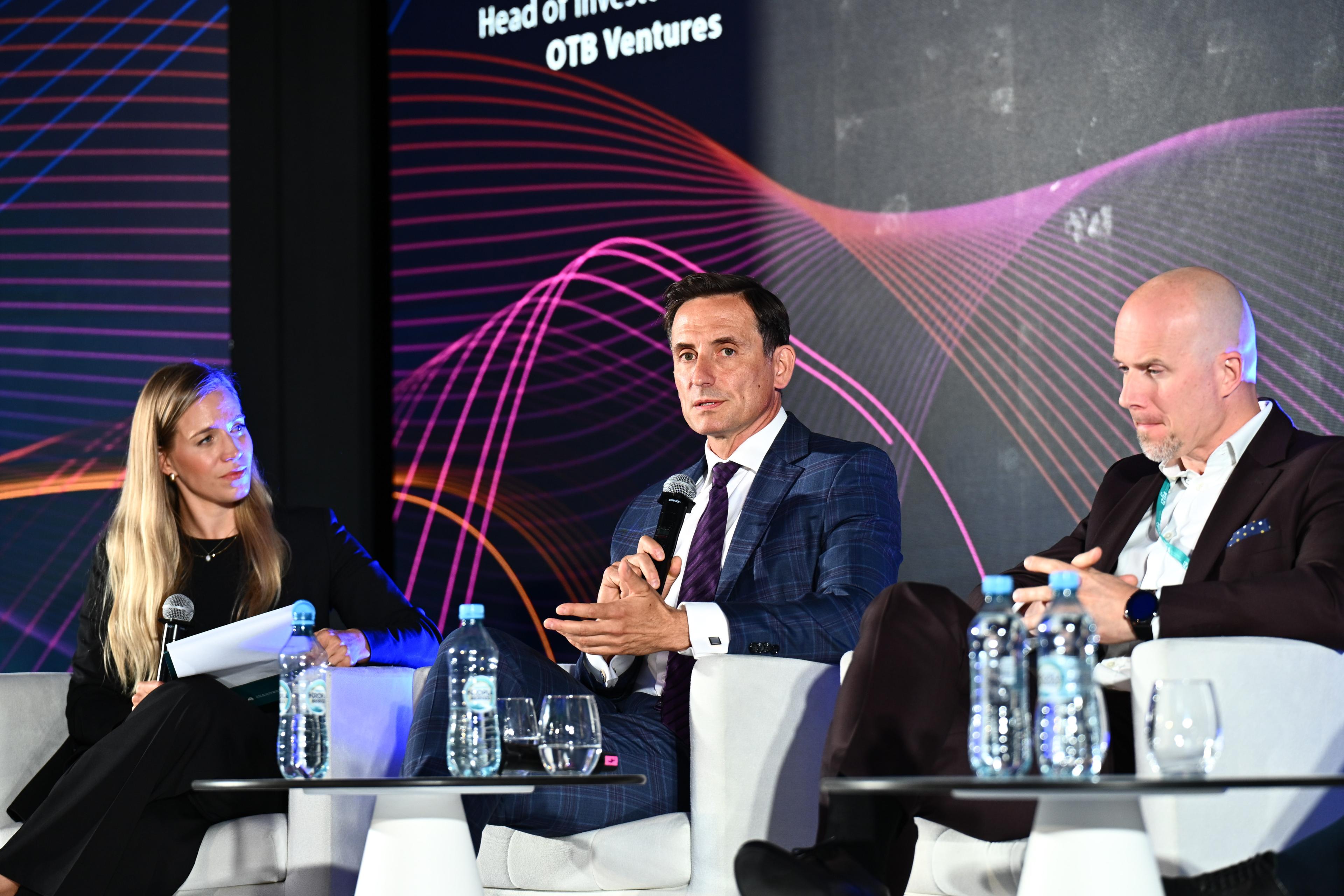
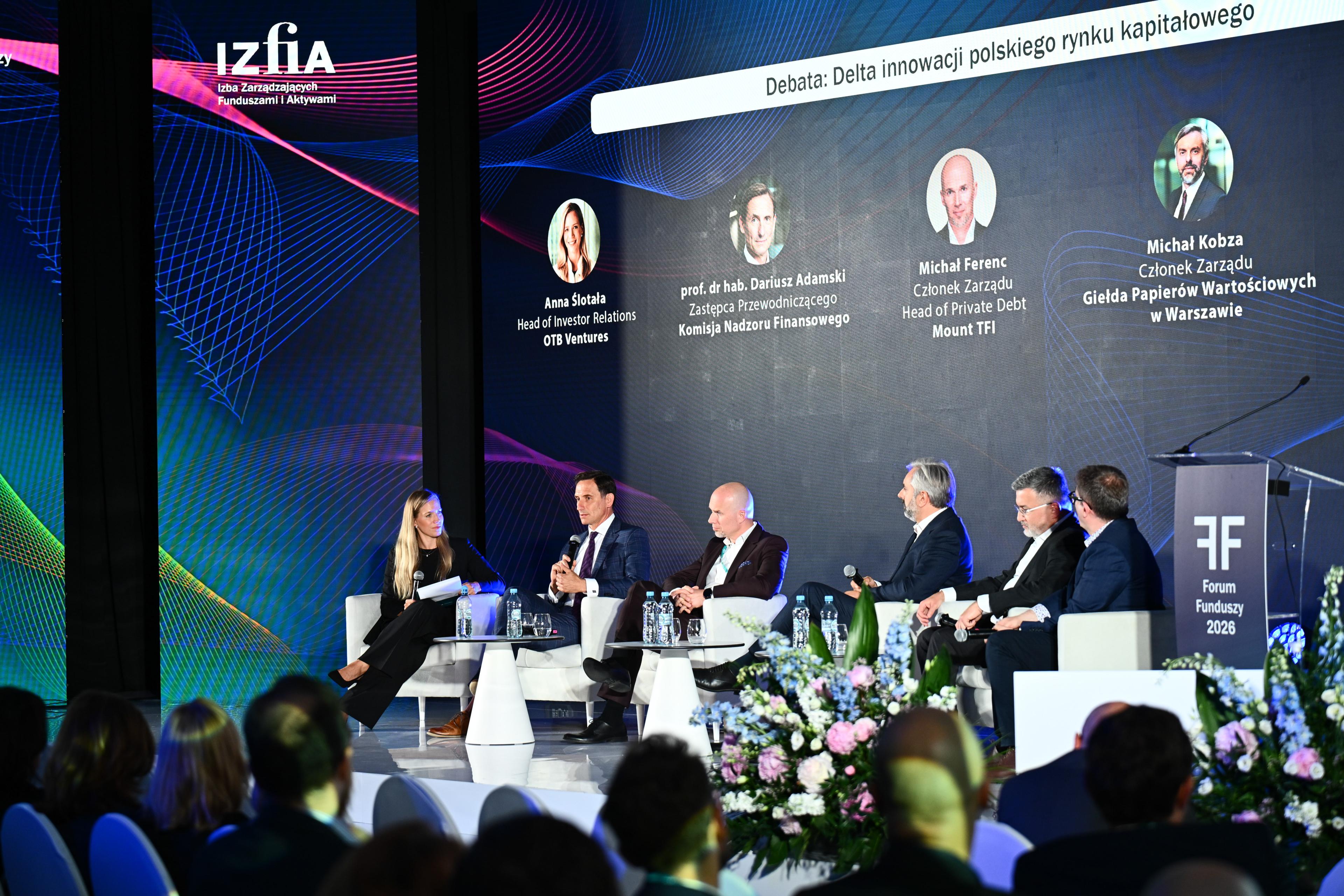
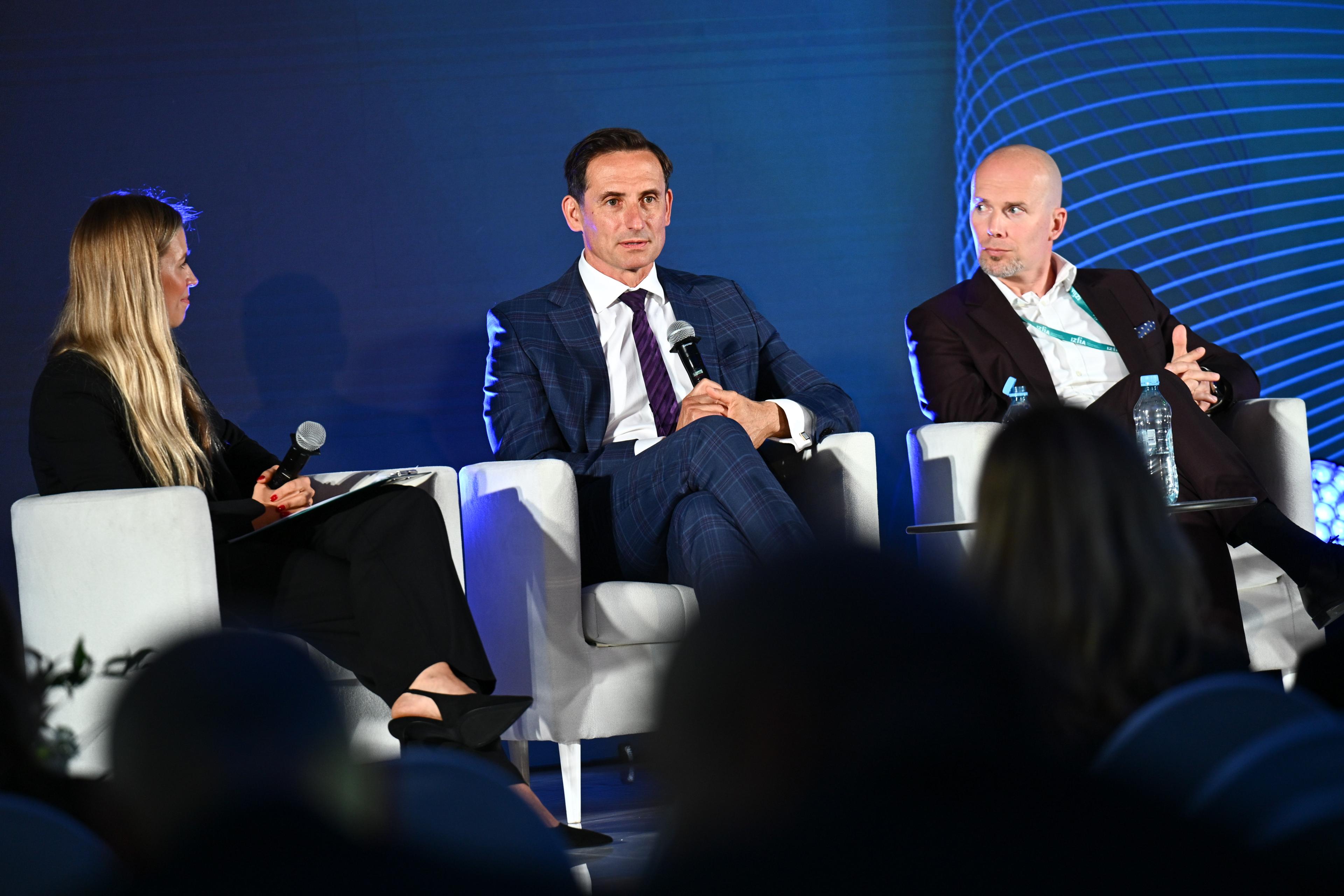
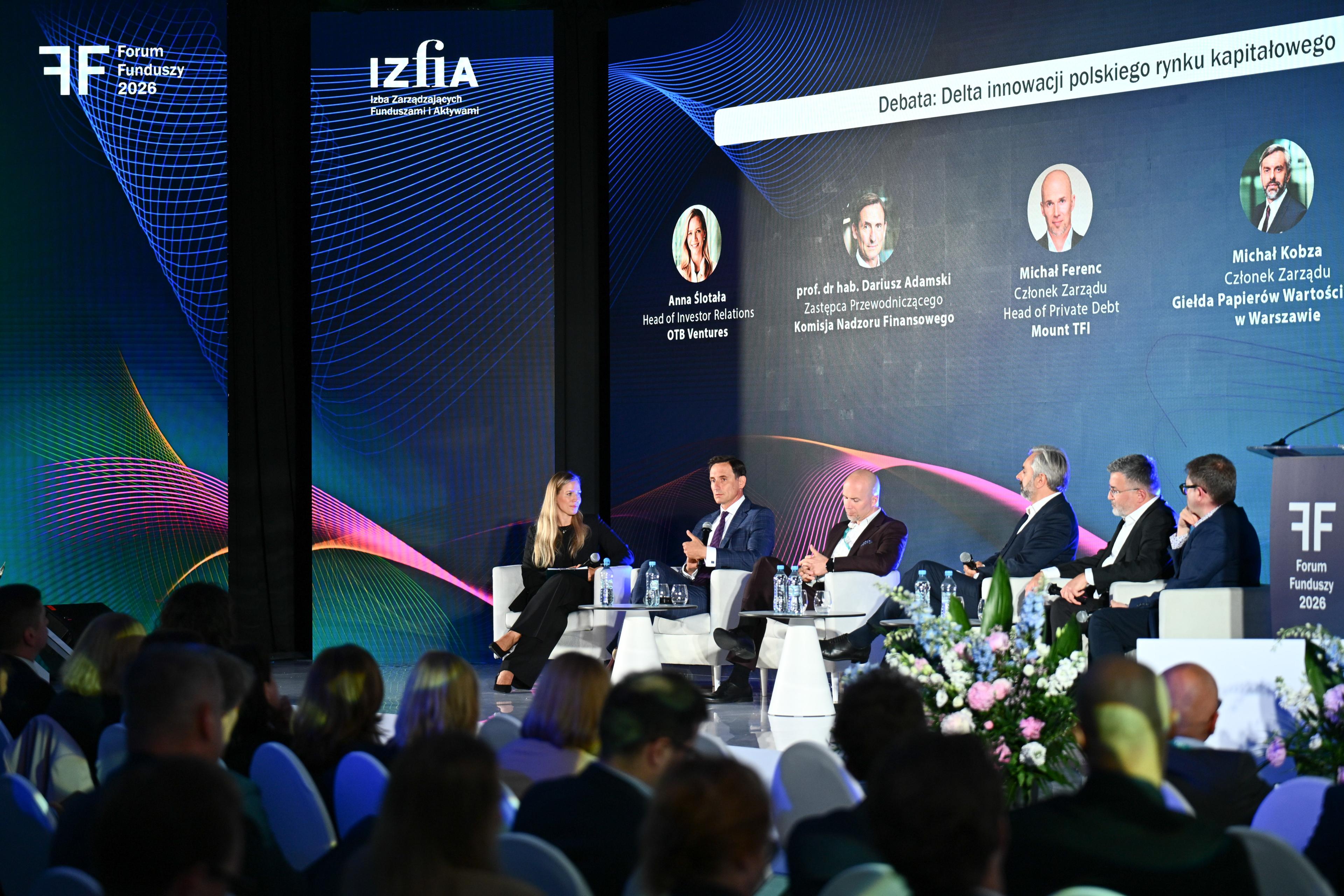
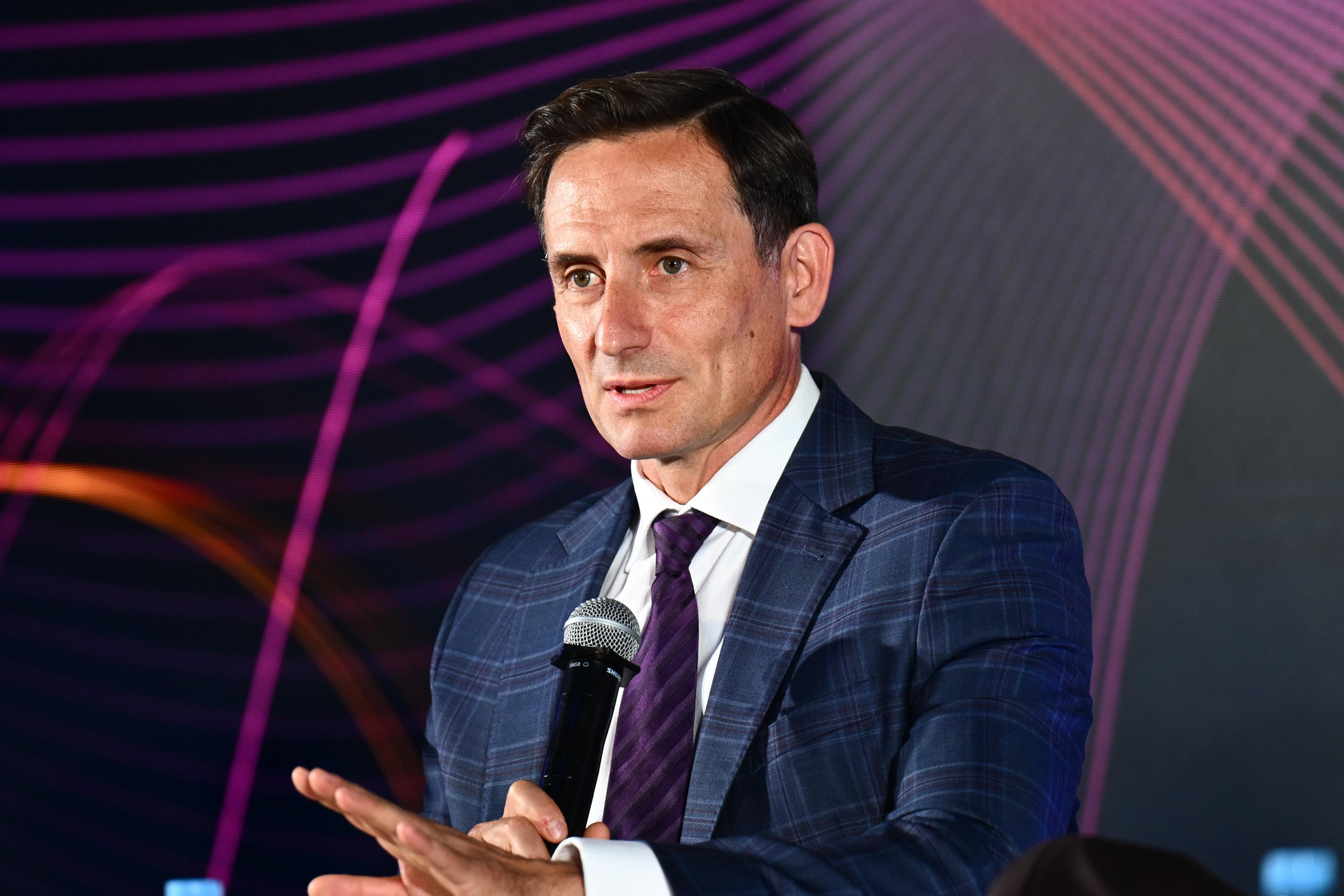
Dariusz Adamski spoke about innovation financing at a debate during IZFiA Funds Forum
Dariusz Adamski, Deputy Chair of the KNF, spoke at a debate titled ‘Innovation Delta of the Polish Capital Market’, held as part of the 20th Funds Forum of the Chamber of Fund and Asset Management (IZFiA). The debate concerned, among other things, the question whether the Polish capital market has a sufficient supply of long-term capital to respond to the growing needs in the area of financing the economy and innovations and why the development of such asset classes as venture capital, private equity and private debt becomes increasingly important for Polish businesses and the economy.
Dariusz Adamski emphasised that the development of employee capital plans (PPK) should be one of key elements in building long-term investments. The existing only quasi-pension model of PPK and IKZE (individual retirement security accounts), beneficial only to people reaching the second tax threshold, cannot respond to demographic challenges, in particular a growing risk of pension poverty. Therefore, both of them require strengthening, mainly through additional tax incentives. He also pointed out that lessons should be learnt from the OFE (open pension funds) experience: pension funds are the foundation of the capital market, they yield high returns and require strengthening and a positive narrative. At the same time, without modifying the slider in the next dozen years, there is a risk of far-reaching negative economic consequences.
He added that pension funds and the capital market should be the foundation of the ecosystem in which the private capital finances the development of businesses, increasingly through the private capital market. A barrier, however, is that Poland remains one of the least innovative economies of the European Union, which is not due to restrictions in the capital market but due to lack of a coherent public policy to support innovations.
Dariusz Adamski also emphasised the importance of appropriate investment risk management in the private capital market. Single projects may involve high risk, but a well-diversified portfolio makes it possible to mitigate it effectively. Competences of management teams and capability to assess the potential of projects at the early stage of development are of key importance. The Innovate Poland initiative should allow financial institutions to gain experience in investing in the private market. At the same time, legislative changes that are underway will allow for more flexibility in the investment policy for PPK and OFE so that those funds could be more involved in long-term development projects.
The Deputy Chair of the KNF also mentioned that financial education supporting the culture of long-term savings will not be enough if invested amounts could be withdrawn at any time. For this reason, it is necessary to further reinforce the ‘pension’ nature of PPK to limit the inefficiencies of short-sighted decisions by retail investors and make a better use of benefits that are derived from long-term investment horizons. This will also lead to a situation in which such institutions, more than now, will be optimal investors in the private capital market.
He also emphasised that investments in non-liquid assets should remain the domain of professional financial institutions, such as pension funds, insurance undertakings or banks as this class of assets is not appropriate for the majority of retail investors.