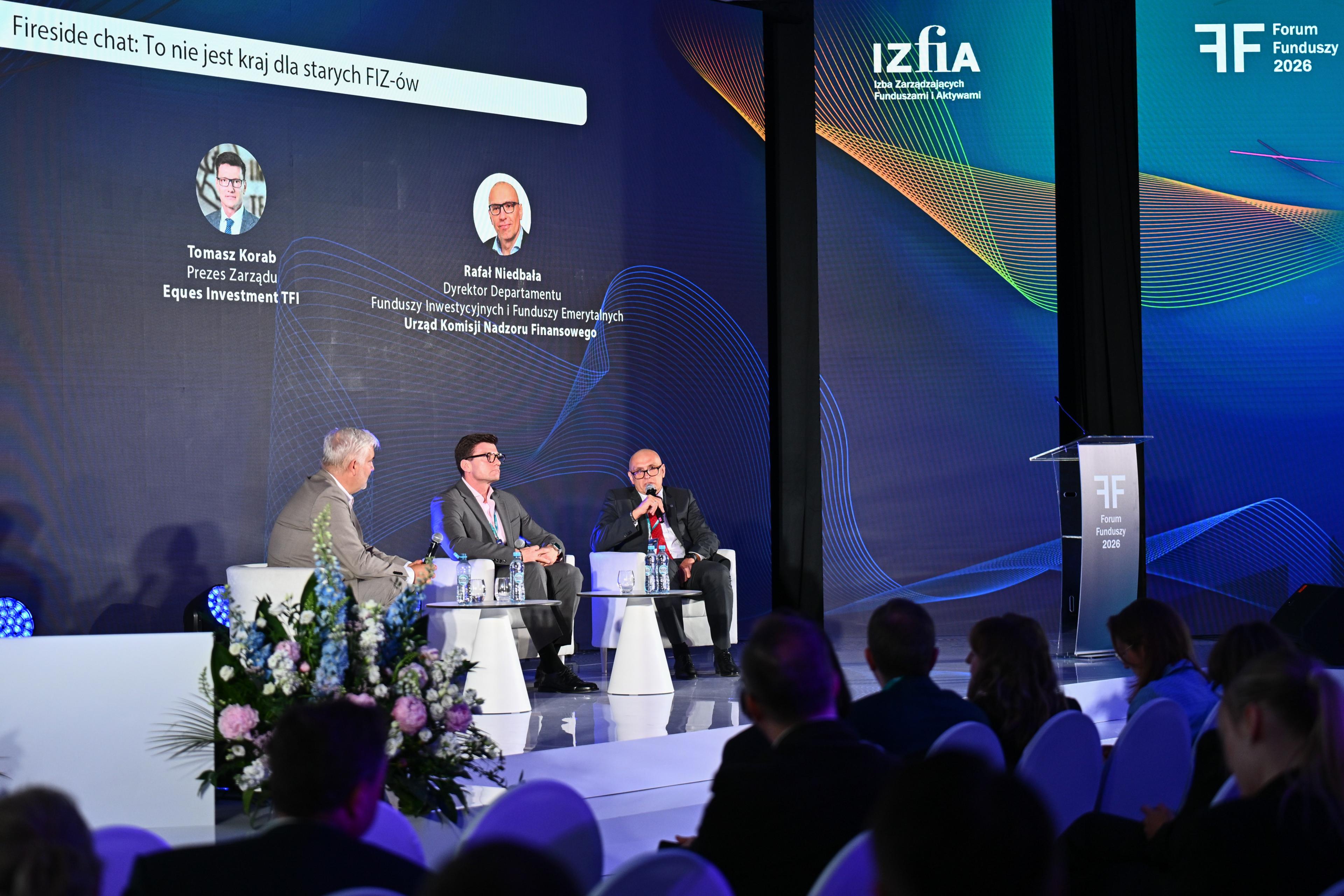
Rafał Niedbała appeared in fireside chat: ‘No country for old closed-end investment funds’ during IZFiA Forum
Rafał Niedbała, Director of the Investment and Pension Funds Department of the UKNF, appeared in the fireside chat: ‘No country for old closed-end investment funds’ during the 20th Funds Forum organised by the Polish Chamber of Fund and Asset Management (IZFiA). The chat focused on how changes in legislation would affect the role and business model of closed-end investment funds (FIZ funds) in upcoming years and, consequently, the product portfolio, market structure, and investor appetite.
According to Rafał Niedbała, one must not treat all FIZ funds as one uniform category, as they vary in their investment strategies, risk levels, and target investors. What’s problematic is not the legal arrangement of closed-end funds, but the business models which turned out to be ineffective and have led to the loss of clients’ trust.
According to Mr Niedbała, the market is no longer a place for ‘old FIZ funds’, i.e. funds that would invest in assets with limited liquidity and, at the same time, declared very frequent redemptions of investment certificates. This kind of arrangements have not met investors’ expectations, and the subsequent lack of confidence in those funds was the consequence not only of single events in the market but, first and foremost, of the mismatch between the product offering and the actual asset management possibilities. On the other hand, there are many categories of closed-end funds which can successfully implement various investment strategies, ensure good performance, and fulfil their obligations towards investors.
Market development does not require fundamental regulatory changes in the area of FIZ funds. For years, the applicable rules have allowed creativity in creating interesting investment products. As an example, Rafał Niedbała mentioned portfolio funds, which – with their transparent strategy, relatively low costs, appropriate liquidity and competitive rates of return – had gained attention among investors. This means that the success of a product is linked primarily to its design and market relevance, rather than the fund’s legal form.
Rafał Niedbała has stressed that closed-end investment funds can play a key role in the market if they provide investors with an appropriate level of transparency and if they are adapted to the nature of allocated assets. He also said that some funds investing in less liquid assets would be naturally addressed to investors who accept higher risk and a long investment horizon, thus becoming less attractive to many retail clients.
Mr Niedbała also highlighted one of the main advantages of FIZ funds’ design: flexibility. Flexibility allows creating products with a much wider scope of investment strategy than traditional UCITS funds, encompassing both various asset classes and different liquidity management models.
According to Mr Niedbała, closed-end funds can be designed as simple, transparent products, for example reflecting specific indices or functioning according to the formula of actively managed ETFs. In his view, FIZ funds could have a major potential for development if the elements baked into the design of such products include a transparent strategy, redemption rules adapted to the strategy, and the capacity to meet the actual needs of investors.